Standard Chair
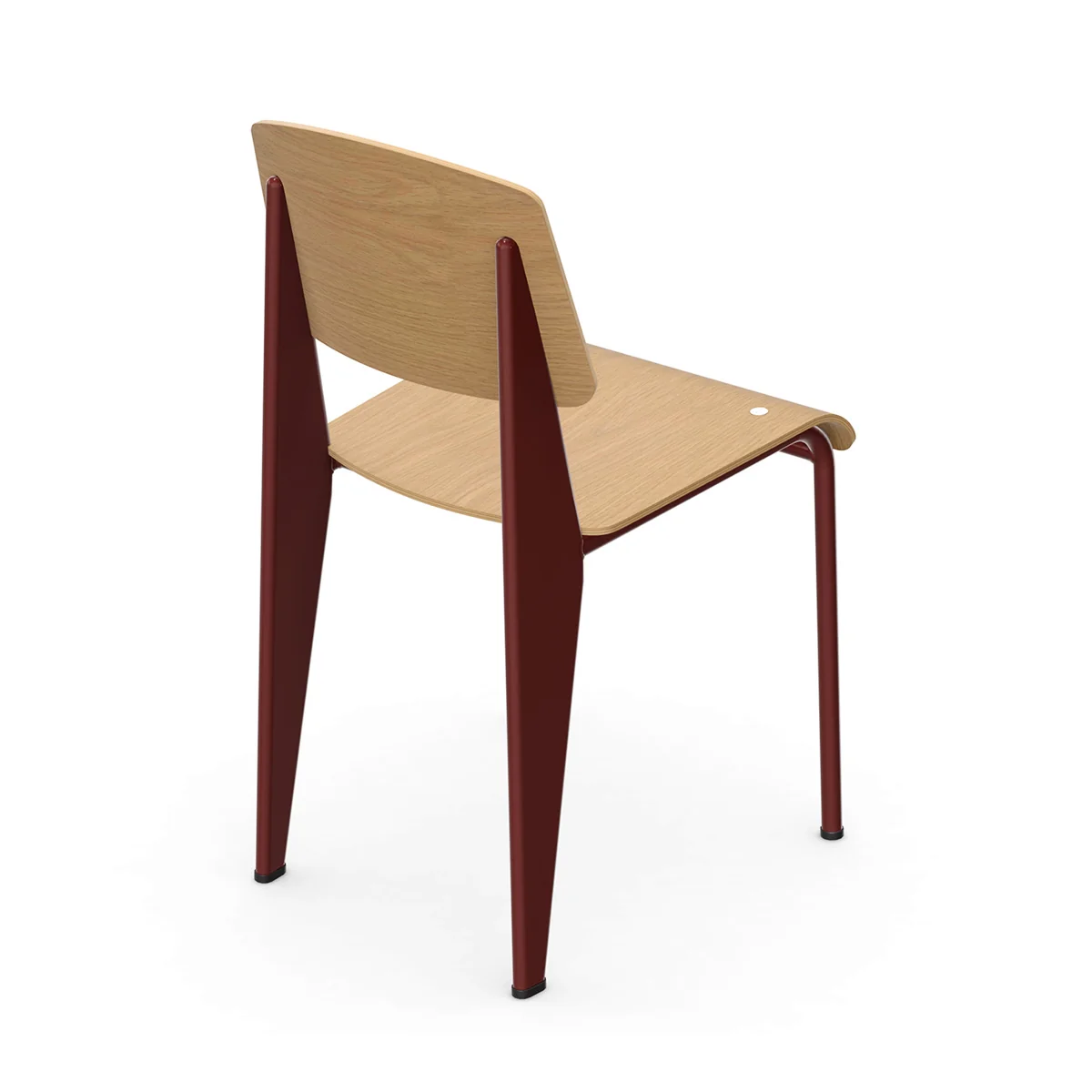
Jean Prouvé conceived the Standard Chair in 1934 from a simple but rigorous observation: the rear legs of a chair carry far greater load than the front. His answer was structural honesty rendered in metal. The back legs are formed from robust, load-bearing hollow sections; the front legs, relieved of that burden, taper into lighter steel tubing. The chair does not perform strength. It is built from it.
Vitra's reissue preserves Prouvé's original engineering logic while refining the finish to contemporary standards. The seat and backrest are shaped from natural oak, warm against the cool precision of the steel. The contrast is not decorative. It is a direct record of how the piece was conceived: each material assigned exactly the role it is suited for.
- Designed by Jean Prouvé, 1934
- Rear legs in load-bearing hollow steel sections
- Front legs in lighter-gauge steel tubing
- Seat and backrest in natural oak
- Suitable for indoor and outdoor use in select configurations
Prouvé trained as a metalworker before becoming one of the most consequential designer-builders of the twentieth century. His furniture emerged from the same discipline as his prefabricated architecture: form derived from function, never imposed upon it. The Standard Chair remains among the clearest expressions of that conviction.
More Images




Standard Chair
Jean Prouvé conceived the Standard Chair in 1934 from a simple but rigorous observation: the rear legs of a chair carry far greater load than the front. His answer was structural honesty rendered in metal. The back legs are formed from robust, load-bearing hollow sections; the front legs, relieved of that burden, taper into lighter steel tubing. The chair does not perform strength. It is built from it.
Vitra's reissue preserves Prouvé's original engineering logic while refining the finish to contemporary standards. The seat and backrest are shaped from natural oak, warm against the cool precision of the steel. The contrast is not decorative. It is a direct record of how the piece was conceived: each material assigned exactly the role it is suited for.
- Designed by Jean Prouvé, 1934
- Rear legs in load-bearing hollow steel sections
- Front legs in lighter-gauge steel tubing
- Seat and backrest in natural oak
- Suitable for indoor and outdoor use in select configurations
Prouvé trained as a metalworker before becoming one of the most consequential designer-builders of the twentieth century. His furniture emerged from the same discipline as his prefabricated architecture: form derived from function, never imposed upon it. The Standard Chair remains among the clearest expressions of that conviction.
Product Information
Product Information
Shipping & Returns
Shipping & Returns
Description
Jean Prouvé conceived the Standard Chair in 1934 from a simple but rigorous observation: the rear legs of a chair carry far greater load than the front. His answer was structural honesty rendered in metal. The back legs are formed from robust, load-bearing hollow sections; the front legs, relieved of that burden, taper into lighter steel tubing. The chair does not perform strength. It is built from it.
Vitra's reissue preserves Prouvé's original engineering logic while refining the finish to contemporary standards. The seat and backrest are shaped from natural oak, warm against the cool precision of the steel. The contrast is not decorative. It is a direct record of how the piece was conceived: each material assigned exactly the role it is suited for.
- Designed by Jean Prouvé, 1934
- Rear legs in load-bearing hollow steel sections
- Front legs in lighter-gauge steel tubing
- Seat and backrest in natural oak
- Suitable for indoor and outdoor use in select configurations
Prouvé trained as a metalworker before becoming one of the most consequential designer-builders of the twentieth century. His furniture emerged from the same discipline as his prefabricated architecture: form derived from function, never imposed upon it. The Standard Chair remains among the clearest expressions of that conviction.