4 Chaise Longue à Réglage Continu, Noire, Durable
First presented at the 1929 Paris Salon d'Automne, the LC4 Chaise Longue à Réglage Continu stands among the most consequential objects of the twentieth century. Conceived by Le Corbusier, Pierre Jeanneret, and Charlotte Perriand, it treats the human body as the true measure of form, a direct expression of Le Corbusier's Modulor proportional system.
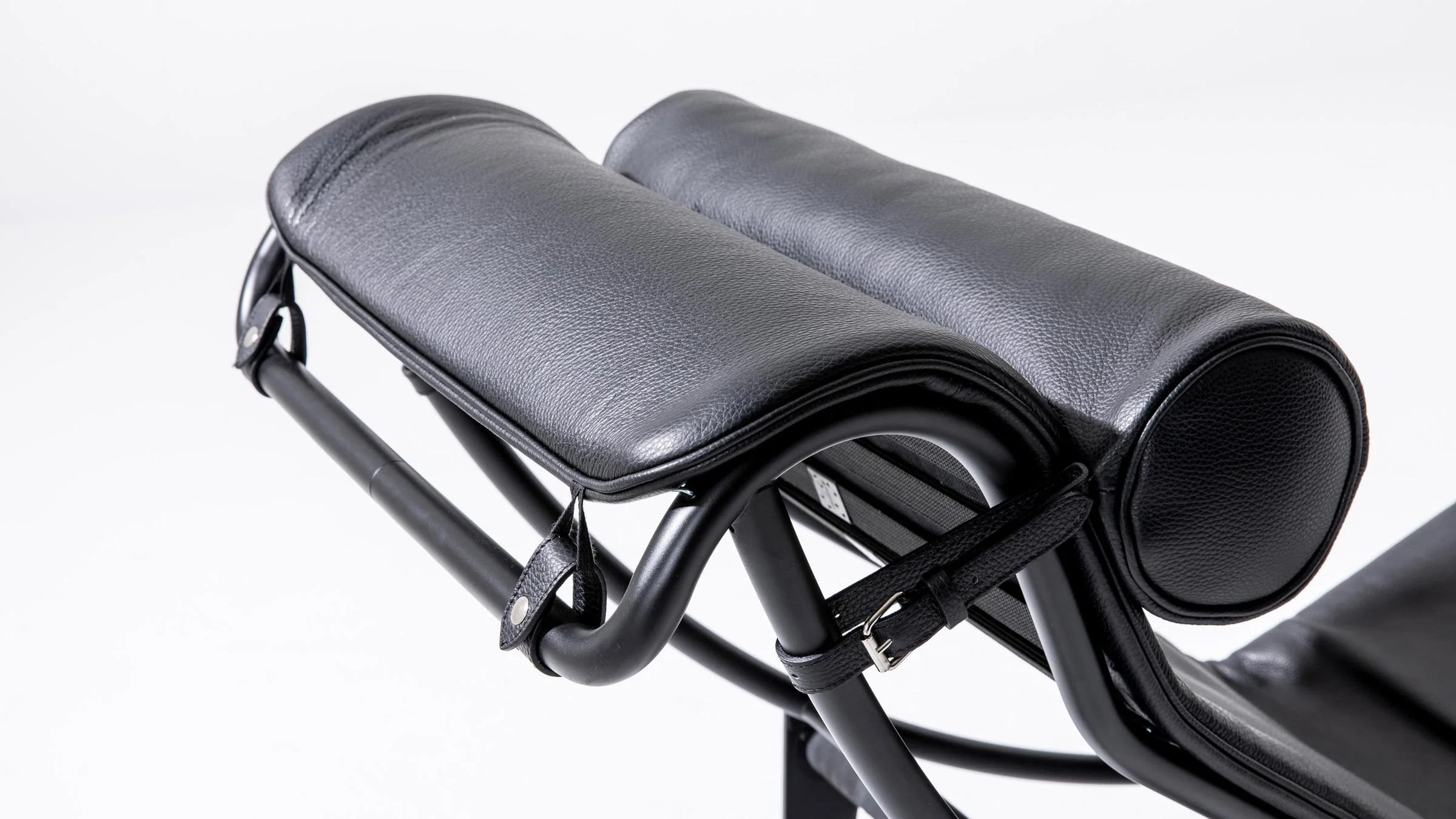
The Noire edition distills the design to its most austere identity. A trivalent steel frame finished in matt black rests on a lacquered base fitted with rubber-sheathed crosspieces, allowing continuous, effortless recline across a full arc of positions. The mechanism is both precise and generous - a quality that has defined this piece across nearly a century of production.
- Trivalent steel frame in matt black
- Lacquered base with rubber-sheathed crosspieces for continuous adjustment
- Three black leather upholstery options, including hair-on hide
- Designed 1928; debuted at the 1929 Paris Salon d'Automne
- Produced by Cassina under license from the Le Corbusier Foundation
Charlotte Perriand's contributions to the LC4 are now widely recognized as foundational. Her ergonomic sensibility and material precision shaped the chaise into something that functions as much as it signifies. The Noire finish gives that legacy a quiet, monolithic presence - one that speaks through proportion rather than ornament.
Original: $6,176.50
-65%$6,176.50
$2,161.77More Images


4 Chaise Longue à Réglage Continu, Noire, Durable
First presented at the 1929 Paris Salon d'Automne, the LC4 Chaise Longue à Réglage Continu stands among the most consequential objects of the twentieth century. Conceived by Le Corbusier, Pierre Jeanneret, and Charlotte Perriand, it treats the human body as the true measure of form, a direct expression of Le Corbusier's Modulor proportional system.
The Noire edition distills the design to its most austere identity. A trivalent steel frame finished in matt black rests on a lacquered base fitted with rubber-sheathed crosspieces, allowing continuous, effortless recline across a full arc of positions. The mechanism is both precise and generous - a quality that has defined this piece across nearly a century of production.
- Trivalent steel frame in matt black
- Lacquered base with rubber-sheathed crosspieces for continuous adjustment
- Three black leather upholstery options, including hair-on hide
- Designed 1928; debuted at the 1929 Paris Salon d'Automne
- Produced by Cassina under license from the Le Corbusier Foundation
Charlotte Perriand's contributions to the LC4 are now widely recognized as foundational. Her ergonomic sensibility and material precision shaped the chaise into something that functions as much as it signifies. The Noire finish gives that legacy a quiet, monolithic presence - one that speaks through proportion rather than ornament.
Product Information
Product Information
Shipping & Returns
Shipping & Returns
Description
First presented at the 1929 Paris Salon d'Automne, the LC4 Chaise Longue à Réglage Continu stands among the most consequential objects of the twentieth century. Conceived by Le Corbusier, Pierre Jeanneret, and Charlotte Perriand, it treats the human body as the true measure of form, a direct expression of Le Corbusier's Modulor proportional system.
The Noire edition distills the design to its most austere identity. A trivalent steel frame finished in matt black rests on a lacquered base fitted with rubber-sheathed crosspieces, allowing continuous, effortless recline across a full arc of positions. The mechanism is both precise and generous - a quality that has defined this piece across nearly a century of production.
- Trivalent steel frame in matt black
- Lacquered base with rubber-sheathed crosspieces for continuous adjustment
- Three black leather upholstery options, including hair-on hide
- Designed 1928; debuted at the 1929 Paris Salon d'Automne
- Produced by Cassina under license from the Le Corbusier Foundation
Charlotte Perriand's contributions to the LC4 are now widely recognized as foundational. Her ergonomic sensibility and material precision shaped the chaise into something that functions as much as it signifies. The Noire finish gives that legacy a quiet, monolithic presence - one that speaks through proportion rather than ornament.